Publication
Omar Shaban Ismail · Francophone Press (via PalThink) · 2018
In this Francophone press interview, Omar Shaban offers a candid assessment of the 2018 Great March of Return: praising the original non-violent idea while criticizing factional contamination, Israel's lethal force, and the human cost borne by Gaza's youth under siege.
In this Francophone press interview, Omar Shaban offers a candid assessment of the 2018 Great March of Return: praising the original non-violent idea while…
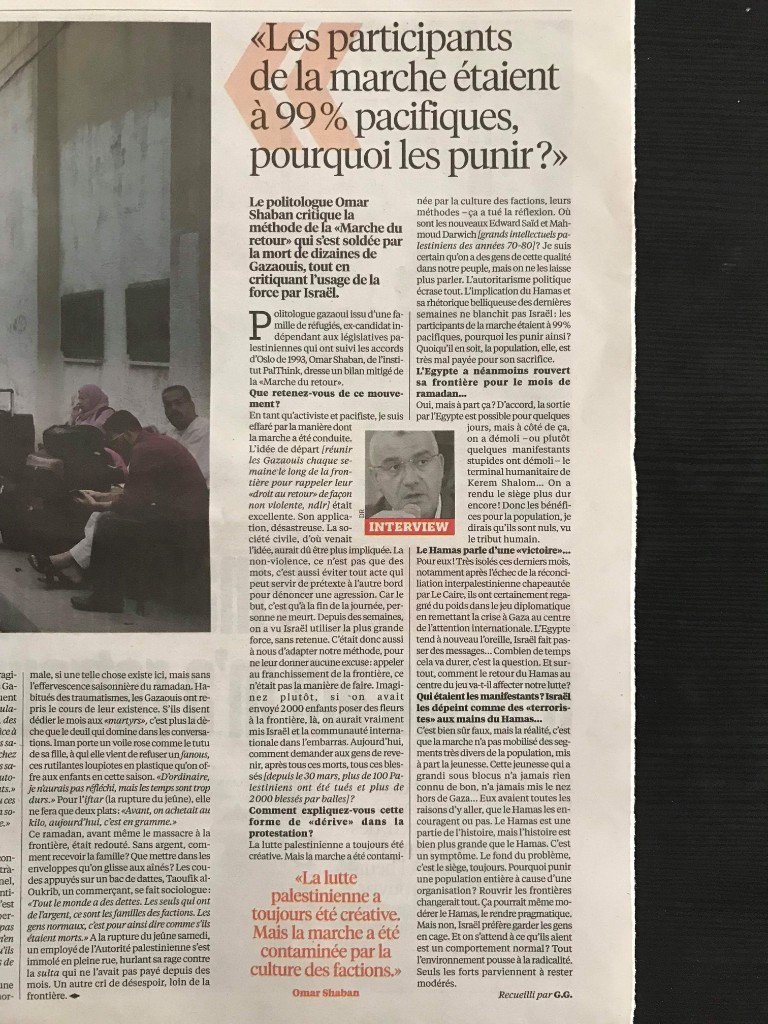
Political scientist Omar Shaban criticizes the method of the "March of Return," which has cost dozens of Gazans their lives, while also condemning Israel's use of force.
A Gaza-born political scientist from a refugee family, a former independent candidate in the Palestinian legislative elections that followed the 1993 Oslo Accords, Omar Shaban of the PalThink institute offers a mixed assessment of the "March of Return."
What do you take away from this movement?
As an activist and pacifist, I am appalled by the way the march was conducted. The original idea — gathering Gazans each week along the border to assert their "right of return" non-violently — was excellent. Its execution was disastrous. Civil society, which was the source of the idea, should have been more involved. Non-violence is not just a slogan; it also means avoiding any act that can serve as a pretext for the other side to claim aggression. Because the goal is that, at the end of the day, no one dies. For weeks, we have seen Israel use maximum force without restraint. It was therefore also up to us to adapt our method so as not to give them any excuse: calling for crossing the border was not the right approach. Imagine instead if we had sent 2,000 children to place flowers at the border — that would have truly put Israel and the international community in an awkward position. Today, how can we ask people to return after all these deaths, all these wounded? [Since March 30, more than 100 Palestinians have been killed and more than 2,000 wounded by live fire.]
How do you explain this kind of "drift" in the protest?
The Palestinian struggle has always been creative. But the march was contaminated by factional culture and factional methods — that killed reflection. Where are the new Edward Saids and Mahmoud Darwishes [great Palestinian intellectuals of the 1970s–80s]? I am certain we have people of that caliber in our society, but we no longer let them speak. Political authoritarianism crushes everything. Hamas's involvement and its belligerent rhetoric in recent weeks do not exonerate Israel: 99% of march participants were peaceful — why punish them like this? In any case, it is the population that pays the heaviest price for this sacrifice.
Egypt has nevertheless reopened its border for the month of Ramadan…
Yes, but apart from that? Fine, exit through Egypt is possible for a few days, but alongside that, we destroyed — or rather, a few foolish protesters destroyed — the Kerem Shalom humanitarian terminal… We made the siege even harsher! So the benefits for the population, I would say, are nil given the human toll.
Hamas speaks of a "victory"…
For them! Very isolated in recent months, especially after the failure of Cairo-brokered Palestinian reconciliation, they have certainly regained diplomatic weight by putting the Gaza crisis back at the center of international attention. Egypt is listening again, Israel is sending messages… How long will that last? That is the question. And above all, how will Hamas's return to the center of the game affect our struggle?
Who were the protesters? Israel portrays them as "terrorists" in Hamas's hands…
That is of course false, but the reality is that the march did not mobilize very diverse segments of the population, apart from youth. This youth, which grew up under blockade, has never known anything good, has never set foot outside Gaza… They had every reason to go, whether Hamas encouraged them or not. Hamas is part of the story, but the story is far greater than Hamas. It is a symptom. The root of the problem is the siege, always. Why punish an entire population because of one organization? Reopening the borders would change everything. It could even moderate Hamas, make it pragmatic. But no, Israel prefers to keep people in a cage. And we expect them to behave normally? The entire environment pushes toward radicalization. Only the strong manage to remain moderate.
— Interview by G.G.
Topic: Gaza Economy — Great March of Return · Gaza Politics · French press · non-violence · Hamas · blockade · pacifism — Original source — PDF